Talk To Our Engineer Now
Before you go, our engineers can review your water quality, process needs, and budget to suggest the right system - share a few details now and get expert feedback
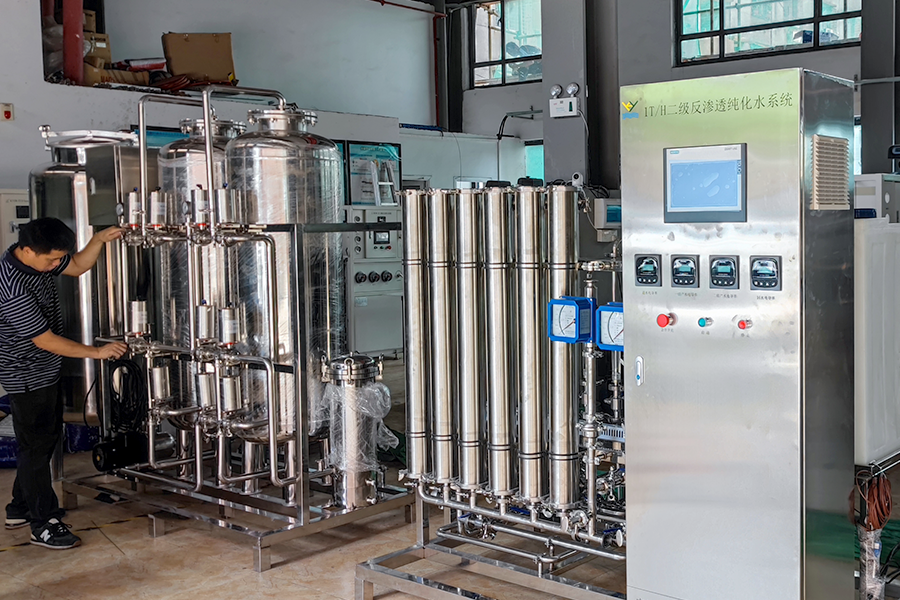
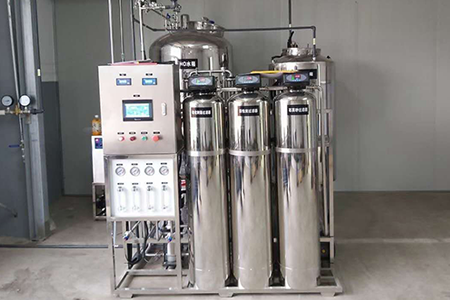
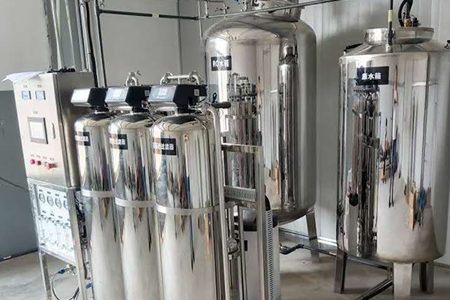
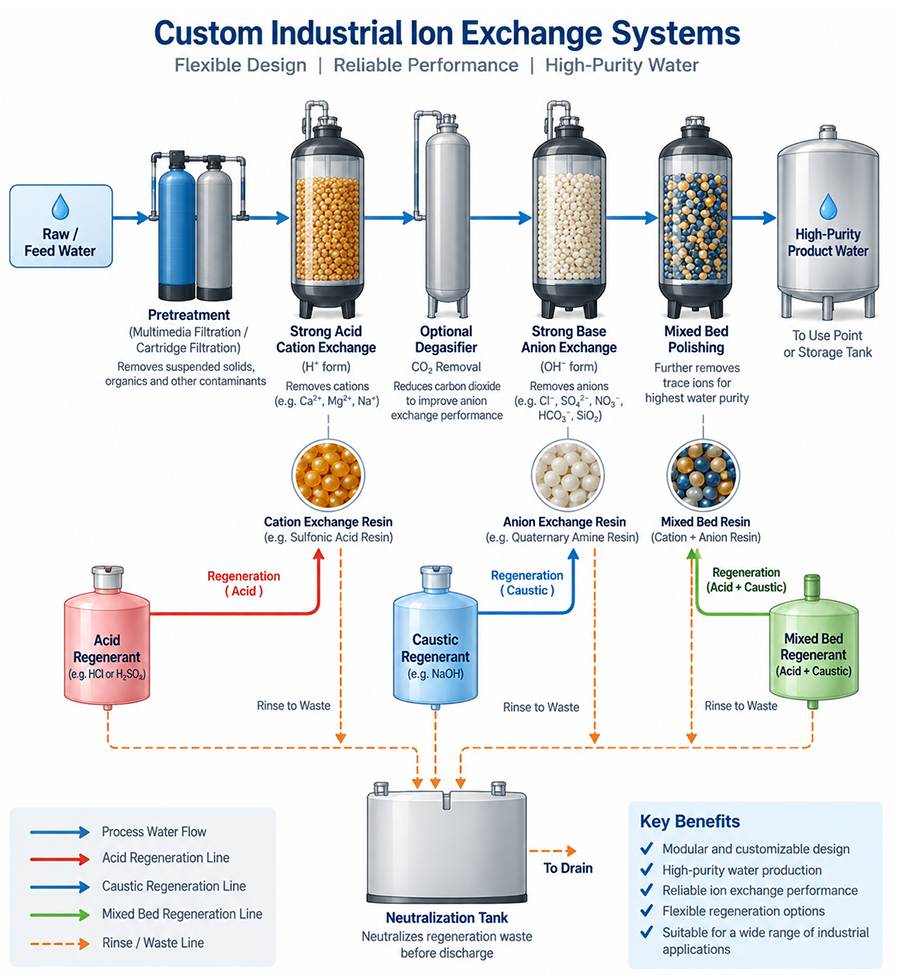
Ion exchange normally works as part of a complete treatment train rather than as an isolated piece of equipment.
A typical industrial configuration may include:
Raw Water → Multimedia Filter → Activated Carbon → Ion Exchange → Cartridge Filter → RO → Final Treatment
Actual process design varies according to the project.
| Criteria | Water Softener | Deionization (DI / IX) |
| Primary goal | Remove hardness (scale control) | Remove a broad range of dissolved ions |
| Typical use | Pretreatment, utility protection | High-purity process water, polishing |
| Result | Hardness reduced; TDS mostly unchanged | Much lower ionic content; higher purity |
| Common pairing | Before RO to reduce scaling risk | After RO for polishing; before/with EDI |
Aqurion supports customers from initial water analysis and process design through equipment manufacturing, factory testing and delivery. Our systems can be configured as single-vessel, duplex, multi-bed, skid-mounted or fully automatic systems according to capacity and operating requirements.
Our supply can include resin vessels, ion exchange resins, regeneration tanks, chemical dosing systems, pumps, valves, piping, instrumentation and PLC controls. We also provide technical drawings, operating documentation, installation guidance, commissioning support and after-sales service to help customers operate the system efficiently and maintain stable treated-water quality.
SEO Title: Industrial Ion Exchange Water Treatment Systems & Solutions
Meta Description: Industrial ion exchange water treatment systems for softening, deionization and targeted ion removal, customized by feed water, flow rate and water quality.
The process of ion exchange takes place as feed water passes through a bed of resin beads containing chemically active exchange sites. These sites have an affinity for particular ions in the water and exchange them with ions already attached to the resin.
In a typical water softener, the resin is initially loaded with sodium. As hard water moves through the bed, positively charged calcium and magnesium ions are attracted to the resin. Sodium ions are released into the water in exchange. Once a significant portion of the available resin capacity has been used, the resin must be regenerated.
Regeneration restores the resin to a usable ionic form. In sodium-cycle softening systems, this commonly involves a brine solution. Other cation exchange and anion exchange applications may require different regenerants according to the resin chemistry and treatment objective.
The required regeneration frequency is not fixed. It depends on feed-water composition, resin loading, operating flow, exchange capacity and the required treated-water specification. Proper system design therefore considers both water production requirements and the practical conditions for chemical storage, regeneration, rinsing and wastewater handling.
For continuous industrial processes, vessel arrangements may also be designed so that one ion exchanger can remain in service while another unit regenerates or remains on standby.
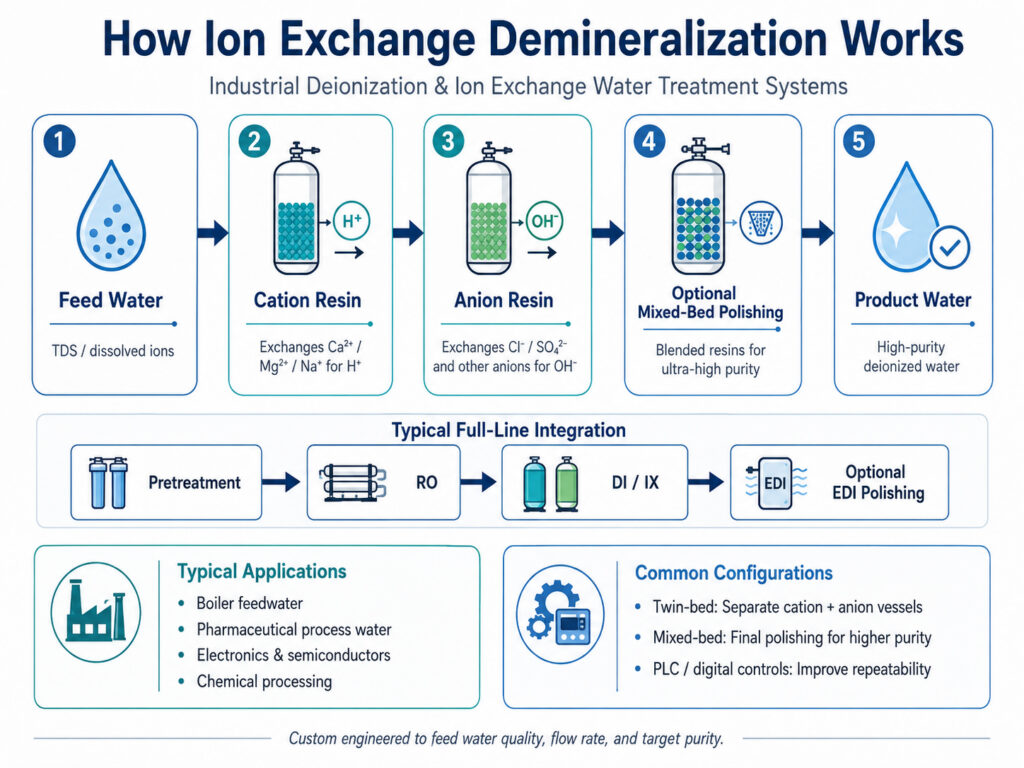
Ion exchange and reverse osmosis are both used to control dissolved contaminants, but they operate differently and solve different water quality issues.
Reverse osmosis uses a membrane and applied pressure to reduce a broad range of dissolved salts and other contaminants. Ion exchange uses resin to target ionic species through chemical exchange. A reverse osmosis system also produces a concentrate stream, whereas ion exchange typically requires periodic resin regeneration instead of continuous membrane concentrate discharge.
For projects focused mainly on water hardness, a water softening system may be used upstream of RO to reduce calcium and magnesium scaling risk. Where lower overall dissolved solids are required, RO systems may perform the main desalination step.
Ion exchange can also be used after RO. For high-purity water applications, polishing resin may remove remaining ionic contaminants from the water after membrane treatment. Depending on final water quality requirements, additional technologies such as EDI may also be considered.
Neither technology is automatically preferable in every project. The decision should be based on feed water, target water quality, specific ions that must be controlled, chemical handling conditions, recovery objectives and downstream process sensitivity.
Correct system selection starts with actual project data rather than a standard equipment size. An RFQ should provide enough information for the treatment process, resin volume, vessel configuration and regeneration method to be evaluated.
| Design Factor | What the Buyer Should Confirm |
|---|---|
| Feed Water | Water source and recent water analysis |
| Required Flow | Normal, minimum and peak operating flow |
| Hardness | Calcium and magnesium concentration |
| Target Ions | Specific ions that must be removed or reduced |
| Treated Water | Required outlet water quality |
| Conductivity / TDS | Confirm where relevant to the treatment objective |
| Resin | Selected according to the required ion exchange process |
| Regeneration | Chemical availability, operating method and site conditions |
| Operating Cycle | Daily operating hours and production pattern |
| Pretreatment | Existing filtration, RO or other treatment equipment |
| Installation | Available space, piping, drainage and utilities |
| Controls | Manual, automatic or PLC-controlled operation |
Water hardness alone is not always enough to design the system. A complete feed water analysis helps identify competing ions, suspended solids, oxidants and other conditions that may affect resin performance.
For industrial water applications, the supplier should also understand what happens after treatment. Water feeding a boiler, reverse osmosis system, chemical process or high-purity water line may require different treatment objectives even when the incoming water source is similar.
Ion exchange resin is selected according to the ions that must be removed and the desired water quality. Using the wrong resin chemistry can reduce operating effectiveness or create unnecessary regeneration requirements.
Cation exchange resins remove or exchange positively charged ions. They are commonly used for water softening and other applications involving calcium, magnesium or selected dissolved metals.
Anion exchange resins interact with negatively charged ions. They can form part of demineralization systems or specialized treatment processes where anionic contaminants must be controlled.
For deionization, cation and anion exchange may be arranged in separate vessels or combined in a mixed-bed polishing stage, depending on the process objective.
Resin loading, exchange capacity and service-cycle length are project-dependent. Regeneration conditions must therefore be considered during equipment design, not after installation. Chemical concentration, contact time, rinsing, waste discharge and automation can all affect how practical the system is to operate.
Resin protection is also important. Where the feed water contains suspended solids, oxidants, organics or other contaminants that may foul the media, suitable pretreatment may be required before the ion exchange stage.
Ion exchange is commonly used across industrial water treatment processes where dissolved ions need to be controlled more precisely than filtration alone can achieve.
Boiler feedwater pretreatment: Water softening reduces calcium and magnesium before the water enters downstream boiler feed treatment equipment, helping control hardness-related scale.
RO pretreatment: Ion exchange water softeners may be installed before reverse osmosis to reduce hardness and lower scaling risk on RO membranes.
High-purity water preparation: Cation exchange, anion exchange or polishing resin may be used with RO and other technologies where low ionic contamination is required.
Pharmaceutical and biotechnology pretreatment: Ion exchange can form part of a multi-stage water purification process before final purification and sanitary treatment stages.
Power generation: Demineralization and polishing processes may be applied where controlled feedwater chemistry is required for steam and power systems.
Electronics manufacturing: High-purity process water may use ion exchange as part of a wider RO, EDI or polishing configuration.
Food and beverage processing: Water softening or selective treatment may be considered where hardness or other dissolved ions affect process equipment or product preparation.
Chemical processing: Specific ions may need to be reduced before water is used as process water, rinse water or feed to other treatment systems.
Cooling-water make-up: Water softening may help manage hardness where scale formation is a concern within the selected cooling-water treatment strategy.
Industrial water reuse and wastewater treatment: Selected ion exchange resins can help treat specific ionic contaminants or polish water after upstream treatment, subject to wastewater composition and project objectives.
Ion exchange removes or replaces dissolved ions rather than suspended particles. Depending on the resin, it can target calcium, magnesium and other positively or negatively charged ions. The exact ions removed depend on the resin chemistry, feed-water composition and required treated-water quality.
Water softening is one application of ion exchange, but the two terms are not identical. Ion exchange water softeners are commonly used for water softening purposes by replacing hardness-forming calcium and magnesium with sodium. Other ion exchange systems may be designed for demineralization, selective ion removal or polishing.
Cation exchange targets positively charged ions such as calcium and magnesium. Anion exchange targets negatively charged ions. The two technologies can be used independently or together, depending on which ions in the water must be controlled and the required outlet specification.
Not necessarily. Ion exchange and reverse osmosis are different water treatment methods. Ion exchange may be used before RO for hardness control, after RO for polishing, or independently for selected treatment objectives. Process selection depends on feed-water chemistry and required product-water quality.
Regeneration restores the working ionic form of the resin after its available exchange sites have been used. The regenerant depends on the resin and application. Sodium-cycle softening commonly uses brine, while other ion exchange processes may require different chemicals and regeneration sequences.
The supplier should receive the feed-water source and analysis, required flow rate, daily operating hours, hardness, target ions, treated-water specification, available utilities, regeneration conditions and details of upstream and downstream water treatment equipment.
Yes. Ion exchange can form part of a high-purity water process, particularly for deionization or final polishing. It may be combined with reverse osmosis, EDI and other treatment processes. The configuration depends on feed-water quality and the required final ionic purity.
For system evaluation, provide your feed-water source, recent water analysis, required flow rate, operating hours, target treated-water quality, hardness or target ions, existing treatment process, application and installation requirements.
This information can be used to evaluate the appropriate ion exchange process, resin selection, vessel configuration, regeneration method and integration with the overall water treatment system.