Talk To Our Engineer Now
Before you go, our engineers can review your water quality, process needs, and budget to suggest the right system - share a few details now and get expert feedback
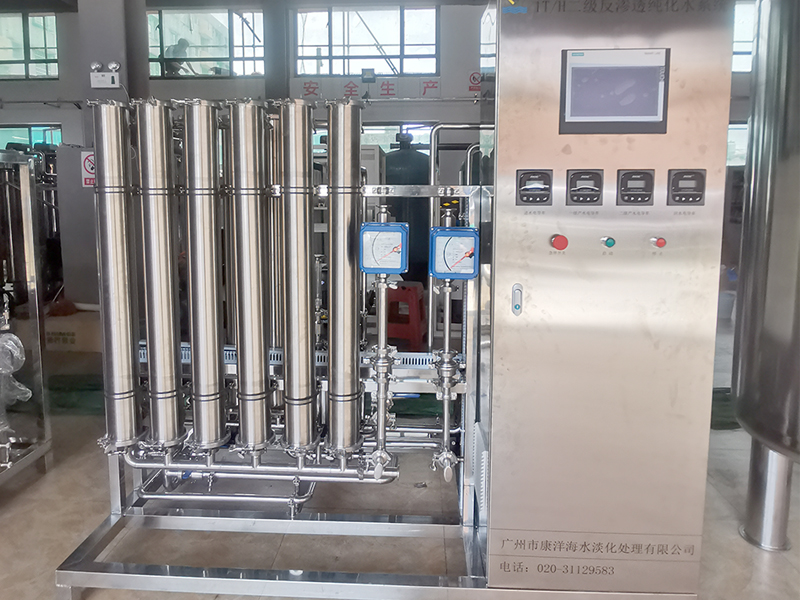
Most projects use multiple treatment stages because one technology rarely controls every relevant contaminant efficiently. The exact sequence is application-dependent.
Media filtration, softening, carbon, cartridge filtration or UF to protect membranes.
Single-pass or double-pass RO for dissolved solids reduction and stable feed quality.
RO+EDI or mixed-bed DI depending purity target, OPEX and operation preference.
UV, ultrafiltration, sanitization and microbial risk control for critical systems.
Storage, recirculation, monitoring and point-of-use quality protection.
| Technology | Primary Function | Typical Role | Key Design Considerations |
| Reverse Osmosis | Reduction of dissolved salts and many other contaminants | Primary membrane purification | Feedwater quality, pretreatment, scaling, recovery and membrane protection |
| Water Softening | Hardness reduction | RO pretreatment where appropriate | Hardness load, regeneration and operating schedule |
| Carbon Filtration | Chlorine and selected organic reduction | Pretreatment | Microbial control, carbon condition and downstream requirements |
| Ion Exchange | Dissolved ion removal | Deionization or polishing | Resin selection, exhaustion and regeneration strategy |
| Electrodeionization | Continuous ionic polishing | Commonly downstream of RO | Feed quality, CO₂, hardness leakage and operating conditions |
| Ultrafiltration | Fine particulate/macromolecular control | Polishing or application-specific barrier | Membrane selection, fouling and sanitization |
| Final Filtration | Point-of-use particle control | Final treatment or distribution protection | Required retention and maintenance strategy |

Use these equipment modules to build a complete treatment train for ultra pure water generation, deionized water systems and laboratory water purification systems.
Service & Support

Every Aqurion project starts with understanding your water source and required product-water quality. Our team evaluates key parameters such as conductivity, hardness, silica, TDS, organic load, microbial control requirements and system capacity before developing the treatment process. Feedwater quality is particularly important when designing RO and EDI systems.
Aqurion can provide process design, RO and EDI systems, pretreatment, polishing equipment, sanitary piping, instrumentation, PLC controls, factory testing, technical documentation, installation guidance and after-sales support, giving customers an integrated solution from water analysis to final system delivery.
The term pure water can describe many different quality levels, which is why specifying only “high purity water” in an RFQ is usually insufficient. The required quality should instead be expressed through measurable parameters and the standards required by the process.
Common design parameters include:
For pharmaceutical water, USP terminology should be used carefully. USP Purified Water is a defined compendial water rather than a generic synonym for any purified water produced by RO. USP identifies Purified Water as water obtained by a suitable process from an appropriate drinking-water source and subject to the applicable compendial requirements.
Installing a certain membrane, EDI module or filtration system does not by itself establish regulatory compliance. The complete production, storage, distribution, monitoring and operational approach must be considered against the applicable quality standards and intended use. FDA guidance also emphasizes monitoring, maintenance, sanitation and the ability of pharmaceutical water systems to consistently produce the required quality.
Pharma and biotech applications require more than low conductivity. System design may also need to address microbiological control, sanitization, storage conditions, distribution design, monitoring and the intended use of the water.
A pharmaceutical facility may use different grades of water for different manufacturing processes. USP Purified Water and Water for Injection, for example, are defined separately and should not be treated as interchangeable. FDA material likewise distinguishes their uses and emphasizes control of pharmaceutical water systems throughout production and distribution.
For life science and laboratory applications, repeatable water quality may be important because trace ionic, organic or particulate contamination can interfere with analytical work, reagents, research procedures or process consistency.
A project may therefore require attention to more than the purification equipment itself. Engineering questions can include:
These questions help determine whether a proposed water treatment solution fits the actual process instead of merely producing an attractive outlet-water specification under nominal conditions.
Semiconductor industries can place particularly demanding controls on ionic, organic and particle contamination. In this context, ultrapure water, often abbreviated as UPW, is normally managed as a complete production and distribution system rather than simply water that has passed through an RO unit.
SEMI maintains dedicated guidance covering UPW system definition, water-quality monitoring and filtration used in semiconductor processing. Its published material also highlights increasingly stringent particle-control requirements as device dimensions shrink.
A semiconductor water purification project can therefore involve pretreatment and RO followed by further deionization, organic reduction, gas control, polishing and fine filtration. Distribution materials, recirculation, monitoring and point-of-use conditions may be just as important as the central treatment systems.
This is also why ultra-pure, high-purity water and general industrial purified water should not automatically be treated as equivalent descriptions. The correct purity levels must come from the process owner’s specification and relevant water standards.
The same principle applies to food and beverage operations and other industrial processes. Some operations need tightly controlled quality water, while others do not require UPW. Adding unnecessary polishing technologies can increase capital cost, chemical treatments, energy demand, wastewater generation and maintenance without improving the manufacturing process.
A water treatment system must work under real operating conditions, not just on a process diagram. System reliability depends heavily on correct pretreatment, sensible equipment sizing, suitable control logic and practical maintenance access.
Membrane fouling or scaling, exhausted resin, unsuitable regeneration practices, changing feedwater chemistry or poor pretreatment can increase downtime and operating cost. Monitoring pressure, conductivity, flow and other relevant operating parameters helps operators identify changes before they become larger production problems.
The engineering scope can also include equipment fabrication, piping and component integration, instrumentation, control-system integration, factory functional testing, documentation and installation guidance. Depending on the project, maintenance planning and replacement consumables can be considered during design rather than after commissioning.
For existing facilities, upgrading does not always require replacing the complete water purification system. The engineering review may identify a bottleneck in pretreatment, RO performance, deionization, storage, distribution or final polishing. Understanding that bottleneck first helps determine whether modification, additional treatment or full replacement is justified.
A technically useful RFQ allows the water treatment supplier to evaluate the process instead of quoting equipment based only on flow rate.
Where possible, provide:
With these inputs, the process can be evaluated around pretreatment, membrane loading, required polishing, water management, operating continuity and future maintenance.
Our approach is to define the required water first, evaluate the feedwater second and then select the water technologies needed to connect those two conditions. That provides a clearer basis for system configuration, technical discussion and quotation.
A high purity water system is an integrated treatment process designed to control selected dissolved ions, organics, particles, microorganisms and other contaminants to a level required by a specific application. Its configuration may include RO, ion exchange, EDI, UV, ultrafiltration and other technologies.
The terms describe different contexts and should not be used as automatic equivalents. Purified Water has a specific meaning when used under USP requirements, while ultrapure water is commonly associated with applications such as semiconductor processing that impose highly demanding contaminant-control requirements. The project specification should define the actual required water purity.
RO may provide the required water quality for some applications, but it is not automatically sufficient for every high purity process. If lower ionic, organic, particulate or microbiological levels are required, additional polishing such as EDI, ion exchange, UV, UF or another process may be needed.
Feedwater chemistry affects membrane selection, pretreatment, fouling and scaling risk, chemical demand and polishing requirements. Designing from an incomplete water analysis can result in inappropriate equipment selection or unstable operating performance.
EDI can reduce the need for conventional chemically regenerated polishing in suitable applications, particularly after RO, but it has feedwater requirements of its own. Ion exchange remains useful in other configurations. The correct choice depends on inlet quality, outlet requirements, operating philosophy and lifecycle considerations.
Yes, in many cases. An evaluation should first determine whether the limitation is caused by pretreatment, membrane capacity, polishing, controls, storage, distribution or another part of the system. Upgrades should target the actual constraint.
Provide your feedwater analysis, required treated-water specification, required capacity, application, operating hours, existing process if applicable, available space, utilities and any project-specific quality, automation, redundancy or sanitization requirements.
For a technical evaluation or quotation, send us your feedwater analysis, required treated-water quality, capacity, application and operating schedule. If you already have an existing water treatment system, include the current process configuration and the problem you want to solve.
Our engineering team can use this information to evaluate the treatment stages, purification requirements, system configuration, controls and integration needs for your project before equipment selection begins.