Talk To Our Engineer Now
Before you go, our engineers can review your water quality, process needs, and budget to suggest the right system - share a few details now and get expert feedback
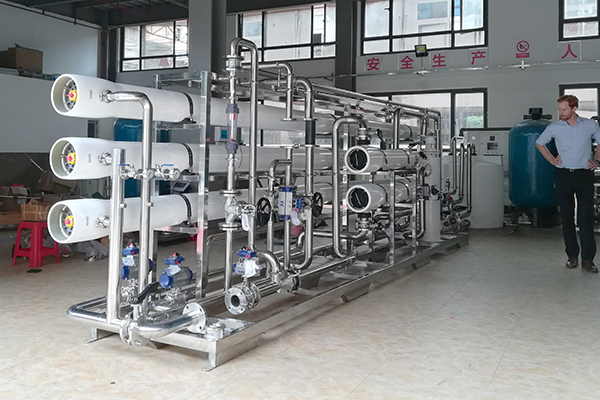
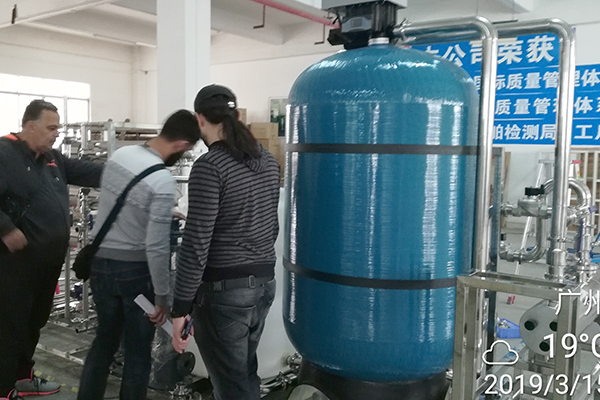
Aqurion supports customers through the complete development of an industrial boiler feedwater treatment project—from initial technical discussion and process design to equipment manufacturing, assembly, testing and project delivery.
We first collect the information required for engineering, including raw water analysis, source water, required treated-water capacity, boiler pressure or application requirements, daily operating hours, existing treatment equipment and target outlet water quality.
Softening or ion exchange may be used when calcium and magnesium need to be reduced before RO or before the boiler.
As a China-based industrial water treatment equipment manufacturer, Aqurion combines engineering with equipment manufacturing and system integration. Depending on the project scope, we can provide individual treatment units or integrated skid-mounted systems assembled with piping, pumps, valves, pressure vessels, instruments, electrical components and control systems.
Before shipment, the system is inspected according to the agreed project requirements. Equipment configuration, piping connections, instruments, pumps, control functions and major components are checked before delivery.
Our work does not end when the equipment leaves the factory. Aqurion can support customers with installation guidance, commissioning information, operating instructions, replacement consumables and technical communication during system operation.
Aqurion ndustrial feedwater treatment systems are normally configured around project-specific conditions. Treatment capacity, pretreatment stages, membrane configuration, pump selection, instrumentation, controls, materials of construction, skid layout, connection standards, chemical dosing points, and monitoring requirements may all vary between projects.
Engineering evaluation should begin with the water analysis and the requirements of the boiler. From there, the treatment sequence can be developed around the contaminants that must be controlled, the required feedwater quality, operating hours, system recovery goals, available space, automation preferences, and any existing treatment equipment.
For retrofit projects, it is also important to understand the current boiler water treatment program, condensate return percentage, existing filtration or softening equipment, feed pump arrangement, and recurring operating problems such as scaling, corrosion, membrane fouling, excessive chemical consumption, or unstable boiler water quality.
Reverse osmosis reduces dissolved salts by forcing pretreated water through a semipermeable membrane. In boiler applications, RO is often considered when the raw water has significant dissolved solids, silica, alkalinity, or other ionic contaminants that would otherwise increase the load on downstream treatment and boiler blowdown.
RO performance depends heavily on pretreatment. Hardness, particulate matter, metals, and other scaling or fouling constituents may need to be controlled before the membrane stage.
Ion exchange is commonly used to remove hardness or, in more extensive demineralization arrangements, reduce ionic contaminants to a lower level.
Softening can be used as the main external treatment for certain boiler applications or as pretreatment before RO when raw-water hardness creates membrane scaling risk. The choice depends on feedwater chemistry, boiler requirements, regeneration considerations, and the complete treatment configuration.
Filtration removes suspended solids and helps protect pumps, valves, membranes, and other downstream components. Depending on the raw water, filtration may involve media filters, cartridge filters, or other separation equipment.
Filtration does not replace dissolved-solids treatment. It addresses suspended material, while technologies such as RO or ion exchange are used for dissolved contaminants.
Deaeration addresses dissolved gases that can contribute to corrosion. Heating the feedwater reduces the solubility of oxygen, while mechanical deaeration and chemical oxygen control can provide additional treatment where required. Returned condensate can also influence the treatment requirement because it is typically hot and has already passed through the steam cycle.
Chemical treatment complements external purification rather than replacing it. Depending on water chemistry and boiler design, various chemicals may be used for corrosion control, oxygen removal, pH or alkalinity management, deposit control, and related treatment objectives.
Actual chemical feed rates and treatment chemicals should be established from water analysis, operating data, and the treatment program.
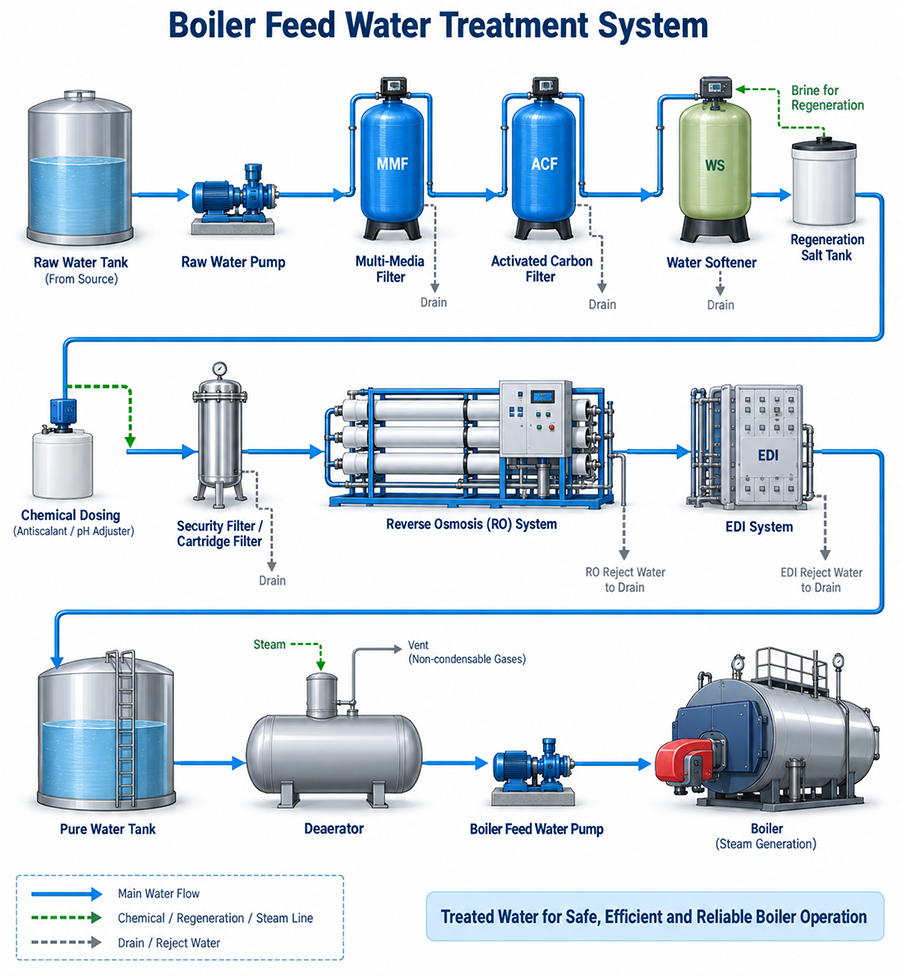
There is no single treatment sequence for every boiler. A typical treatment process is built around the contaminants present in the water source and the quality of boiler feedwater required by the plant.
The final treatment train must be based on raw-water analysis, boiler operating pressure, steam requirements, makeup water demand, recovery objectives, condensate return, and local operating conditions.
Untreated water can contain dissolved minerals, suspended particles, dissolved gases, and other impurities that behave differently as water is heated and concentrated inside the boiler. Calcium and magnesium hardness can contribute to scale on the boiler and boiler tubes, while silica can form difficult deposits under certain water chemistry conditions. Suspended solids can accumulate as deposits or interfere with downstream treatment equipment.
Even a thin layer of scale can reduce heat transfer efficiency because deposits create additional thermal resistance between the combustion side and the boiler water. Severe deposition may lead to overheating, cleaning requirements, or unscheduled downtime. The American Society of Mechanical Engineers publishes consensus guidance addressing feedwater and boiler water chemistry with the objective of reducing corrosion, deposition, frequent cleaning, and operating problems in industrial steam systems.
Corrosion presents a different challenge. Dissolved gases, particularly oxygen and carbon dioxide, can attack feed tanks, piping, feed pump components, boiler surfaces, and condensate systems. Effective feedwater treatment therefore considers both external treatment before the boiler and appropriate internal treatment or chemical treatment within the overall water treatment program.
Boiler feed water treatment systems can be configured around different water sources, boiler requirements, treatment capacities, and site conditions. Depending on the project, the treatment train may combine pretreatment, filtration, water softening, ion exchange, reverse osmosis, deaeration, chemical feed, and polishing stages. The correct configuration is selected according to water analysis, feedwater quality targets, steam generation requirements, condensate return, operating pressure, and plant operating conditions.
Hardness and scaling: Hard water contains calcium and magnesium compounds that can form deposits when water is heated or concentrated. Scaling on heat-transfer surfaces can interfere with efficient boiler operation and increase the need for mechanical or chemical cleaning. Softening, membrane treatment, or other processes may therefore be required before water enters the boiler system.
Dissolved solids and silica: As steam is generated, many non-volatile dissolved solids remain behind and become more concentrated in the boiler water. Reverse osmosis and demineralization technologies can reduce the dissolved-solids load entering the boiler. Silica is particularly important in certain higher-purity steam and turbine applications, so the required silica control level must be determined from the requirements of the boiler and downstream equipment.
Suspended solids: Particulate matter can create deposits and can also foul membranes, ion exchange equipment, valves, and other water systems. Appropriate pretreatment or filtration systems help remove suspended solids before more sensitive treatment stages.
Dissolved gases and corrosion: Oxygen and carbon dioxide are important corrosion concerns in feedwater and condensate systems. Heating, deaeration, chemical treatment, or a combination of methods may be used depending on the installation. Spirax Sarco notes that oxygen is a major cause of corrosion in feed tanks, feed lines, pumps, and boilers, while carbon dioxide can further increase corrosive conditions.
Poor water management can therefore affect boiler efficiency, reliability, maintenance frequency, steam quality, and the condition of boiler and downstream equipment.
System selection starts with actual project data. Before specifying equipment, engineers and procurement teams should establish the characteristics of the incoming water and the operating requirements of the steam system.
Important information includes water source, hardness, conductivity or total dissolved solids, silica, alkalinity, suspended solids, iron or other relevant contaminants, required feedwater flow, daily operating hours, boiler pressure, makeup-water demand, and condensate return.
The quality of boiler feedwater required can vary significantly between different boiler designs and operating pressures. For that reason, values from organizations such as the American Boiler Manufacturers Association or the American Society of Mechanical Engineers should be considered together with the boiler manufacturer’s requirements and the specific operating program rather than treated as one universal specification for all boiler equipment.
Site conditions also affect equipment selection. Available footprint, drain arrangements, automation level, chemical storage, operator involvement, membrane cleaning access, connection standards, and wastewater treatment or discharge limitations can influence the final system configuration.
Where a cooling tower or cooling tower water system is part of the same facility, its water treatment needs should be evaluated separately. Boiler feedwater and cooling water operate under different concentration and chemistry conditions and should not automatically be assigned the same treatment strategy.
Boiler feedwater treatment systems are used wherever reliable steam generation depends on controlled feedwater chemistry. Applications can include industrial steam boilers in manufacturing plants, food and beverage facilities, pharmaceutical production, chemical processing, textile operations, institutional boiler rooms, process plants, and power-related facilities.
The treatment configuration should reflect the process rather than simply the industry name. A facility operating a low-pressure process boiler may require a different feedwater treatment approach from a plant producing high-purity steam or supplying steam to a turbine.
The same principle applies to water applications involving hot water systems, process water, condensate recovery, or combined boiler and cooling tower infrastructure. Each water stream should be evaluated according to its own chemistry, temperature, equipment sensitivity, and operating purpose.
Properly designed feedwater treatment can support several practical operating objectives.
Reducing hardness and scale-forming contaminants helps protect heat-transfer surfaces and can reduce the risk that deposits reduce heat transfer efficiency. Managing dissolved oxygen and carbon dioxide supports corrosion control in the boiler, feedwater circuit, and condensate system.
Reducing dissolved solids before the boiler can also support more stable boiler water chemistry and may reduce unnecessary blowdown where operating chemistry permits. Better control of incoming contaminants can simplify downstream water management and help maintain consistent water conditions during normal operation.
The objective is not simply to produce treated water. The treatment system should support the operating requirements of the entire steam generation process, including feedwater preparation, chemical treatment, boiler operation, condensate return, and protection of downstream equipment.
To evaluate a suitable treatment configuration, provide the raw-water source, recent water analysis, required flow rate, boiler operating conditions, operating hours, desired feedwater quality, existing pretreatment, available installation space, and automation requirements.
With this information, the treatment stages can be evaluated against actual project specifications instead of relying on a generic boiler feed water treatment package.
The required treatment depends on raw-water chemistry, boiler design, operating pressure, condensate return, and the required feedwater quality. A system may include filtration, softening, RO, ion exchange, deaeration, and chemical treatment. Not every boiler requires every stage, so water analysis and operating data should be reviewed before equipment selection.
No. Reverse osmosis is useful when dissolved solids, silica, alkalinity, or other ionic contaminants need to be substantially reduced, but some boiler systems may operate with properly softened and chemically treated makeup water. The decision should be based on feedwater analysis, boiler requirements, operating economics, and downstream water chemistry objectives.
Ion exchange softening may be installed before RO when hardness needs to be reduced to lower the risk of membrane scaling. Whether softening is necessary depends on raw-water hardness, alkalinity, membrane design, recovery target, and pretreatment strategy. Other approaches may be appropriate depending on the complete water analysis and RO system design.
Hardness, silica, and other dissolved minerals can contribute to deposits as boiler water becomes heated and concentrated. Dissolved gases such as oxygen and carbon dioxide can promote corrosion in feedwater and condensate circuits. Controlling these constituents before and during boiler operation helps protect heat-transfer surfaces, piping, and related equipment.
Treatment capacity is based primarily on boiler makeup water demand rather than boiler nameplate capacity alone. Engineers should consider steam production, condensate return, blowdown, operating schedule, peak demand, system recovery, storage requirements, and treatment losses. These factors determine the required feedwater treatment flow and influence equipment sizing.
Useful project information includes the raw-water source, complete water analysis, required feedwater flow, boiler operating pressure, operating hours, condensate return, required feedwater quality, current treatment equipment, available space, automation preferences, and discharge conditions. These inputs allow the treatment of boiler makeup water to be matched to actual system requirements.