Talk To Our Engineer Now
Before you go, our engineers can review your water quality, process needs, and budget to suggest the right system - share a few details now and get expert feedback

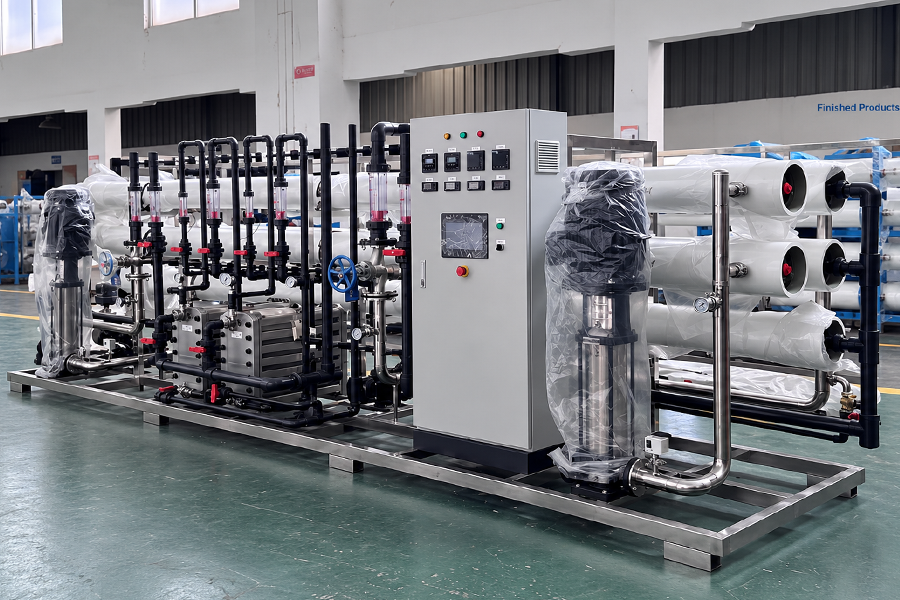
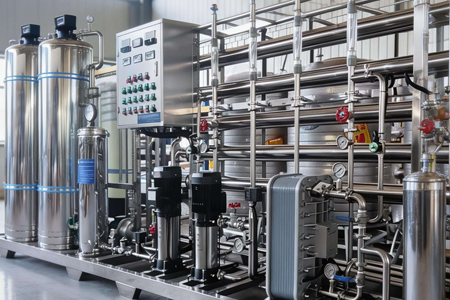
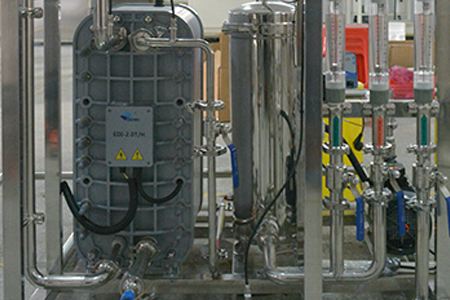
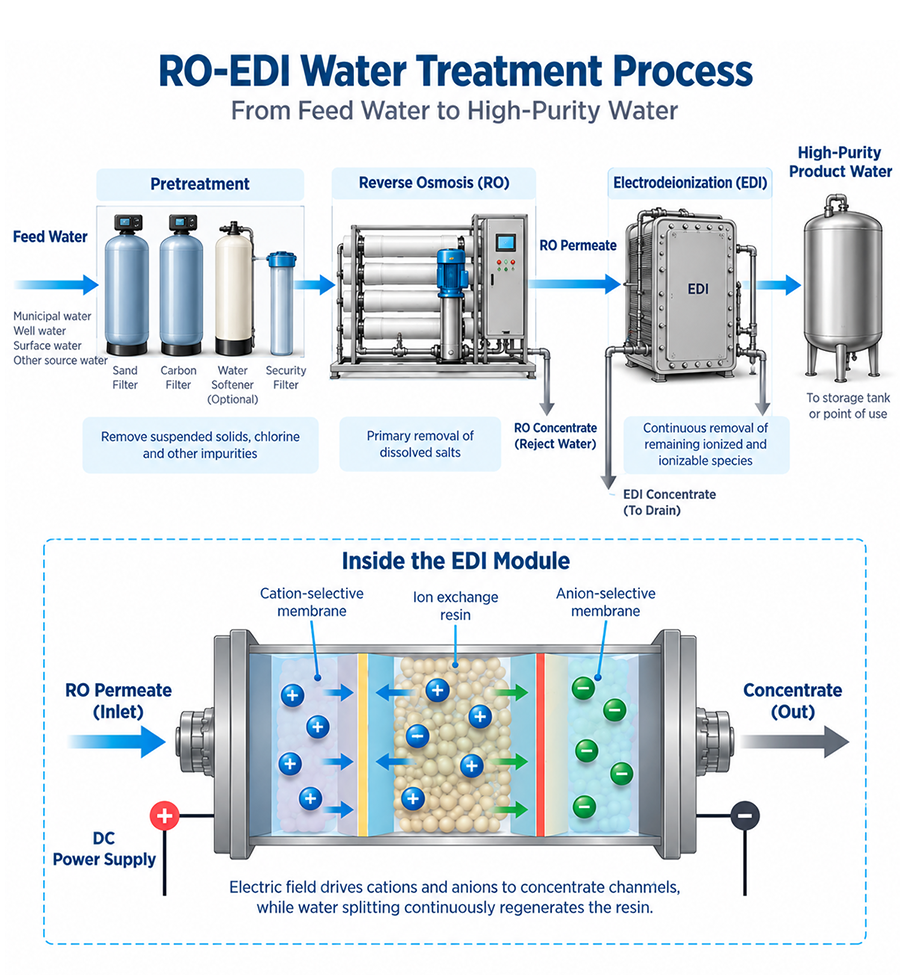
At Aqurion, we engineer RO and EDI as one treatment train. Reverse osmosis performs the primary dissolved-solids reduction, and EDI then polishes the RO permeate to reduce the remaining ionized and ionizable species.
Source water enters the treatment system from municipal, well, surface, or other industrial water sources. Water chemistry is reviewed to determine suitable pretreatment and downstream process requirements.
Pretreatment reduces suspended solids, chlorine, hardness, and other contaminants that may affect RO performance. The exact process is selected according to the source-water quality.
The RO membrane removes most dissolved salts and ionic contaminants, producing lower-conductivity permeate for the following polishing stage and a separate concentrate stream.
EDI uses ion-exchange resin, selective membranes, and DC power to continuously remove residual ionized and ionizable species from RO permeate without routine chemical resin regeneration.
After EDI polishing, high-purity product water is sent to storage, distribution, or downstream treatment for use in applications requiring controlled water quality.
| Decision Factor | RO-EDI / Electrodeionization | Conventional Regenerated Ion Exchange |
| Chemical handling | Continuous electrical regeneration within the EDI process | Periodic chemical regeneration is normally required |
| Regeneration | Reduces routine reliance on acid and caustic regeneration chemicals | Requires chemical storage, handling and regeneration systems |
| Operation | Designed for continuous operation when feedwater conditions are suitable | Regeneration can require cycling or standby capacity |
| Feedwater | Requires appropriately conditioned water, normally RO permeate | Can accommodate different water conditions depending on design |
| Automation | Integrates readily into automated RO treatment trains | Depends on vessel, valve and regeneration arrangement |
| Maintenance focus | RO performance, water chemistry, module condition and electrical operation | Resin condition, regeneration sequence and chemical equipment |
| Economics | Influenced by power, pretreatment, RO efficiency and system configuration | Influenced by chemicals, water use, neutralization and regeneration |
At Aqurion, we use RO-EDI when the required water quality is beyond what the RO stage alone is expected to deliver.
Reverse osmosis performs the primary salt reduction, while EDI provides continuous polishing of residual ionized and ionizable contaminants remaining in the permeate.
We define the required product-water target project by project.
Depending on the feedwater, pretreatment, RO configuration, EDI design and operating conditions, we may evaluate water quality using parameters such as:
We do not assume that every EDI system will produce the same outlet quality.
Some commercial EDI technologies are capable of producing water at very high resistivity. For example, DuPont publishes product-water performance up to 18 MΩ·cm for certain EDI modules under defined operating conditions. This is manufacturer-specific performance data rather than a universal guarantee for every RO-EDI installation.
For semiconductor production, pharmaceutical facilities and other applications with stringent water quality requirements, the specification may also include very low contaminant levels or additional downstream polishing.
In these projects, we may design EDI as one stage within a larger high-purity or ultrapure water treatment system rather than assuming that EDI will always be the final treatment step.
At Aqurion, we pay particular attention to RO permeate quality because EDI performance depends strongly on the condition of the water entering the module.
The RO stage therefore has a direct influence on EDI stability, product-water quality and long-term service and maintenance requirements.
During engineering, we review important parameters such as conductivity, hardness, silica, carbon dioxide, temperature, pressure, flow and the remaining dissolved ionic load after RO.
We also consider particulate contamination, oxidants and other upstream conditions that may affect module performance. DuPont’s technical documentation specifies that its EDI modules are designed to deionize RO permeate and that feedwater must comply with defined module-specific requirements.
Carbon dioxide is particularly important. Dissolved CO₂ can behave differently from dissolved ionic salts during RO treatment and may contribute additional load to the EDI process.
Silica must also be considered during engineering. EDI can remove ionizable species associated with silica and carbon dioxide, but actual performance depends on the composition of the feedwater and the characteristics of the selected EDI module. DuPont and Veolia both describe EDI as capable of removing residual ionized or ionizable species from properly treated water.
We therefore do not use one generic EDI feedwater specification for every project. Module manufacturers publish their own feed water requirements, and we compare those requirements with the actual RO permeate and project conditions.
For an RFQ, we recommend sending us a complete source-water analysis together with information about any existing pretreatment. This gives our engineering team a stronger basis for selecting the pretreatment, RO configuration, EDI module and supporting equipment.
At Aqurion, we evaluate RO and EDI for applications where stable, low-ionic-content water is important to production quality, equipment protection or downstream process control.
Pharmaceutical and biotechnology facilities
We can incorporate RO-EDI into purified water generation or upstream purification systems. For these projects, we also evaluate materials, sanitary design, documentation requirements and integration with storage and distribution loops.
Semiconductor and electronics production
High-purity water is used to reduce ionic and particulate contamination during sensitive manufacturing and cleaning processes. Depending on the required specification, RO-EDI may form part of a broader ultrapure water treatment train.
Power generation and boiler feedwater
We can use RO-EDI to generate low-mineral-content makeup water for boiler feedwater and steam-cycle applications. Controlling ionic impurities is important for reducing undesirable deposits and contamination within downstream equipment. EDI technology is widely used for power-generation makeup-water polishing.
Laboratory and high-purity industrial processes
For laboratory and industrial applications requiring enhanced water purity, we can integrate EDI ahead of final purification cartridges or other polishing stages.
We may also evaluate RO-EDI for chemical processing and selected food or beverage applications where controlled purified water is part of the process requirement.
Rather than recommending RO-EDI solely according to the industry name, we review the actual product-water specification and process conditions before determining the appropriate treatment configuration.
We normally design EDI to receive appropriately treated RO permeate rather than untreated source water. During engineering, we review conductivity, hardness, silica, carbon dioxide, oxidants, temperature and other relevant conditions against the requirements of the selected module.
Exact limits depend on the EDI technology and should be confirmed during system design.
We use reverse osmosis to remove most of the dissolved salt load before the polishing stage.
This reduces the ionic load reaching the EDI module and creates more suitable conditions for continuous deionization. EDI then removes residual ionized and ionizable species remaining in the RO permeate.
EDI does not normally require the routine acid and caustic regeneration associated with conventional regenerable mixed-bed ion exchange.
Within the EDI process, H+ and OH- ions generated through water splitting continuously regenerate the ion-exchange media while the electrical field drives contaminant ions toward the concentrate stream.
We design the product-water target according to the actual application rather than promising one universal EDI outlet specification.
The achievable quality depends on feedwater chemistry, pretreatment, RO configuration, the selected EDI module and operating conditions. We therefore confirm conductivity, resistivity, silica or other required parameters during engineering.
We normally start with your source-water analysis, required product-water quality, required flow rate, operating schedule and application.
We also recommend providing information about existing pretreatment, available installation space, utilities, temperature, redundancy requirements, controls, storage and distribution systems.
Both technologies can be used to polish demineralized water.
EDI uses membranes, ion exchange resin and an electrical field for continuous deionization. A conventional mixed bed uses ion exchange resins that eventually require regeneration or replacement.
At Aqurion, we compare them according to feedwater chemistry, product-water targets, chemical handling, operating strategy, maintenance and lifecycle economics.
Operating costs are influenced by power consumption, RO efficiency, pretreatment, feedwater chemistry, concentrate handling, pumping requirements, maintenance and the overall treatment configuration.
When comparing RO-EDI with conventional ion exchange, we recommend evaluating the complete treatment train rather than considering EDI electricity consumption alone.
At Aqurion, our goal is to select and configure the RO-EDI system around your actual water conditions and process requirements.
Send us your feedwater analysis, required product-water quality, required capacity, application, operating schedule, existing pretreatment and site conditions.
Our engineering team can then evaluate the required pretreatment, reverse osmosis configuration, EDI polishing stage, controls and system integration, providing a more practical basis for preliminary system selection and quotation.