Get The Quote In 60 Minutes

Share your water quality and project requirements today to receive a tailored industrial water treatment system from our engineer team within 1 hour.
Popup Form

Ultra-Pure Water Treatment RO EDI Systems

Our RO/EDI hybrid systems combine Reverse Osmosis (RO) with continuous Electrodeionization (EDI) to deliver stable, high-purity water for demanding operations—pharma, semiconductor, power & boiler feed, food & beverage, labs, and more.

RO/EDI Hybrid Water Treatment Systems

RO/EDI is the go-to approach when your process demands high-purity water with stable performance—and you want to avoid the chemicals, downtime, and waste handling of conventional regeneration-based deionization.
Continuous EDI polishing can reach ultra-high resistivity water for critical production steps, rinse lines, and boiler feed applications.
Skid-mounted or container-ready designs allow fast deployment and easy scaling by adding RO or EDI modules in parallel.
EDI continuously regenerates internally (via electric field and membranes), reducing acid/caustic handling, neutralization, and disposal burdens.
Typical placement
Operators, plant managers, engineers, procurement
Best for
Stable 24/7 ultra-pure production
Buyers
Operators, plant managers, engineers, procurement

How RO and EDI Work Together

RO removes the bulk of dissolved salts and contaminants. EDI then polishes RO permeate continuously, stripping remaining ions using DC power, ion-exchange membranes, and resin.
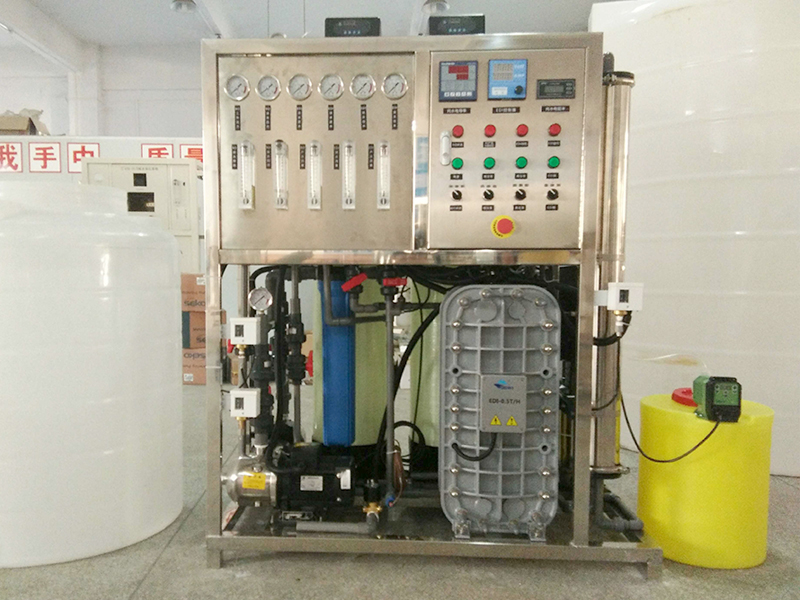
ro edi water treatment 1
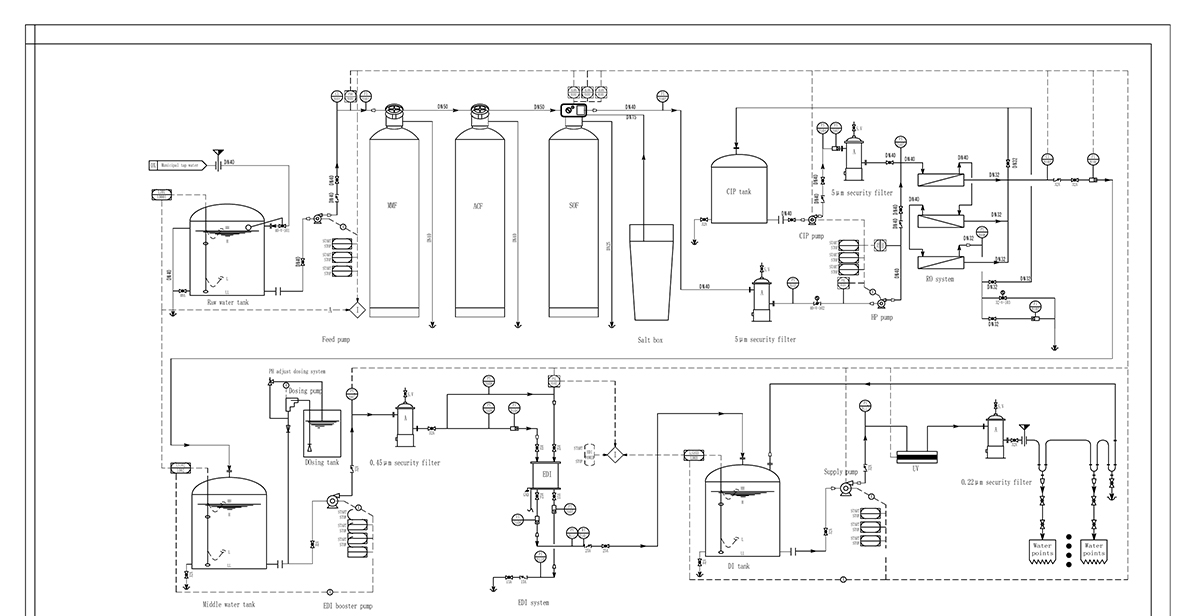
Process Flow (Typical)
Pretreatment → RO (single/double pass) → EDI polishing → Optional UV/Final filtration → Use point

01. Feed Water Intake

Feedwater enters the container. Online instruments can track pressure, flow, and conductivity for stable operation.

.

02. Pretreatment

Media/carbon filtration, softening, chemical dosing, and cartridge filtration help protect RO membranes and reduce fouling.

03. RO Desalination

High-pressure pumping drives the membrane separation. Permeate and concentrate streams are managed to achieve target recovery.

04. Post-treatment

Optional UV, chlorination, pH adjustment, blending, or remineralization can be added to meet potable or process standards.
BWRO EDI PID

System Design & Integration

We engineer RO/EDI systems as part of a complete treatment train—so pretreatment, RO performance, and EDI polishing work together reliably.
Complete Pretreatment (Built to Protect RO/EDI)
Common modules include media filtration, cartridge filtration, water softening, and optional ultrafiltration (UF) to reduce fouling risk and stabilize feed conditions.
Media filters: sand / carbon option
Softening: hardness control for scale prevention
UF (optional): turbidity & colloid reduction
Dosing: antiscalant / dechlorination when needed
RO + EDI Configuration Options
Typical architecture uses RO permeate as the EDI feed. Choose single-pass or double-pass RO, then size EDI stacks to achieve your target conductivity/resistivity.
Skid-mounted: plant-room installation
Container-ready: fast deployment worldwide
PLC/HMI: standard automation
Remote access: optional telemetry
Instrumentation & Safety Interlocks
Flow, pressure, and conductivity/resistivity sensors with alarms and protective shutdown logic.
Modularity & Redundancy
Parallel trains and N+1 strategies available to match uptime targets and maintenance plans.
Integration with Your Other Systems
Pairs naturally with UF pretreatment, brackish/seawater RO trains, media filtration, and containerized solutions.

Key Benefits of RO/EDI High-Purity Water Systems

RO/EDI is engineered for stability, safety, and efficiency—especially when you need continuous output and tighter quality control.
Consistent Operation
Continuous deionization means stable quality—no regeneration cycles interrupting production.
Reduced Downtime
Fewer shutdowns for regeneration and reduced maintenance overhead—better uptime for operators.
Compliance-Ready Controls
PLC/HMI, conductivity/resistivity monitoring, alarms, logs, and optional remote supervision.
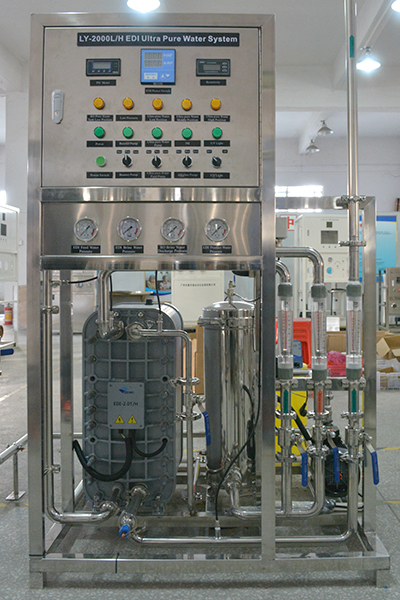
ro edi water treatment
Lower Chemical Burden
Eliminates routine acid/caustic regeneration and reduces handling, storage, and neutralization needs.
Improved Total Cost of Ownership
Lower spend on regenerant chemicals and waste treatment; simplified O&M planning.
Scalable Architecture
Expand capacity by adding RO trains or EDI stacks in parallel—without redesigning the whole plant.

EDI vs Traditional Deionization (Regenerable Ion Exchange)

Both can produce high-purity water—difference is how they operate day-to-day. EDI is continuous and typically avoids routine chemical regeneration workflows.
Decision FactorRO/EDI (Continuous Electrodeionization)Traditional DI (Regenerable Ion Exchange)
Operating modeContinuous polishing after ROBatch cycles with regeneration events
Regeneration chemicalsTypically no routine acid/caustic regenerationRequires acids/caustic (or offsite service exchange)
Downtime riskReduced downtime from regeneration schedulingRegeneration/servicing can interrupt production
Waste handlingLower chemical handling burden (site-dependent)Neutralization/disposal planning is often required
FootprintCompact modular stacksOften larger tanks or regeneration equipment footprint
Best fit24/7 high-purity demand + strong compliance focusIntermittent demand or where regeneration logistics are acceptable

Frequently Asked Questions

Quick answers for operators, engineers, and procurement teams evaluating RO/EDI.
information we need for a quote
Required flow, feedwater analysis (TDS/hardness/silica/organics), target quality, space/power constraints, and whether you prefer skid vs containerized format
Contact Us
Mon – Friday, 10-19 PM

Request a Quote / Talk to an Engineer

Share your flow, feedwater data, and purity target. We’ll recommend a practical RO/EDI configuration with clear options for pretreatment, automation, footprint, and scalability.

Get a Custom RO/EDI Proposal

Designed for operators, engineers, and procurement teams—fast, specific, and easy to compare. A complete RO/EDI package engineered for 24/7 operation—optimized for consistent quality, lower OPEX, and simplified compliance.
What you get
EDI polishing after RO
RO removes most dissolved solids; EDI continuously removes remaining ions with DC power.
Service flow range
Typical EDI module service flows span from small systems to high-throughput industrial lines.
Automation + monitoring
PLC/HMI, conductivity/resistivity tracking, alarms, data logging, and optional remote access.
Turnkey integration
Pretreatment, RO, EDI, and optional UV/UF polishing—one integrated responsibility.
Product Form